It usually sounds like a gunshot. You're in the house, the garage door is in use — or sometimes just sitting closed — and a sharp bang comes from the garage. You go to check and the door won't move, or barely budges when you try to lift it manually.
That sound is almost always a torsion spring snapping. It's one of the most common garage door problems we see across San Diego County, and it can happen to any door at any age — though most springs give out somewhere between 7 and 12 years in.
Here's what you need to know: what to do right now, what it'll cost, and how to keep it from happening again.
1. Stop using the door immediately
The spring carries the door's full weight — roughly 150–400 lbs depending on the door. Without it, that weight falls on the opener motor, which can burn out in seconds. Worse, the door can drop suddenly and cause serious injury.
If you need to get your car out of the garage before help arrives, disconnect the opener by pulling the red release cord, then manually lift the door slowly with both hands. Don't do this alone — the door is heavy without a working spring, and it can slip. Do not leave the door propped open, as it can fall without warning.
Once it's safe, call a licensed tech. Spring repair is genuinely not a DIY job — more on that in a moment.
2. How to tell if a spring is broken
The loud bang is the most obvious sign, but not every spring failure is that dramatic. Here's what to look and listen for:
The door won't open, or barely moves
If you hit the opener button and the motor strains but the door doesn't move — or moves a few inches and stops — the spring is either broken or has lost tension. The opener is fighting the full weight of the door alone.
You can see a gap in the spring coil
Torsion springs sit on a metal rod above the door opening. Look up there. If you see a gap of 2–3 inches in the coil, the spring has snapped. This is a sure sign.
The door is uneven or tilted
Most double-car doors use two torsion springs. If one breaks and the other doesn't, the door will sag or tilt on the broken side when you try to open it.
The top of the door bends or buckles
Trying to open a door with a broken spring sometimes bends the top panels. This is the opener forcing the door up without the spring's help. Stop immediately if you see this happening.
Squeaking, grinding, or slow operation
Springs that aren't broken yet but are near the end of their life often make noise or move more slowly than usual. This is a good time to replace them proactively rather than wait for the snap.
3. Torsion springs vs. extension springs
San Diego garages use two types of springs, and the repair process differs slightly for each.
Torsion springs (most common)
A torsion spring is a tightly wound coil mounted horizontally on a metal rod above the door. When the door closes, the spring winds up and stores tension. When you open the door, that tension releases and helps lift the door. Most homes built in San Diego County in the last 25 years use torsion springs — they're safer, more balanced, and longer-lasting than the alternative.
Extension springs
Extension springs run horizontally along the tracks on each side of the door. They stretch as the door closes and contract as it opens. They're less common in newer construction but still found in many older homes and some commercial doors in San Diego.
Extension springs should always have safety cables running through them. If a spring breaks, the cable catches it and prevents it from flying across the garage — which can cause serious injury or damage. If your cables are frayed or missing, replace them at the same time as the springs.
4. Can you fix a garage door spring yourself?
Technically, the parts are available at hardware stores. Practically, this is one repair where the savings genuinely aren't worth the risk.
Torsion springs store an enormous amount of tension — enough to cause severe injury or death if released suddenly. Every year, emergency rooms across California treat people who were hurt attempting DIY spring replacement: broken hands, lacerations, and worse. Professional technicians use specialized winding bars, calibrated tools, and follow strict safety protocols built from years of training.
Beyond safety: getting the spring size wrong (wrong wire gauge, wrong length, wrong turn count for your door's weight) will mean the door either won't balance or the spring will fail prematurely. Sizing a spring correctly requires knowing the door's exact weight, height, and track radius — not guesswork.
Lubricating the springs once or twice a year with a garage door spray lubricant (not WD-40, which dries out) is a safe and effective way to extend spring life. That's about it.
5. What does spring repair cost in San Diego?
There is no single number, because the price depends on your door. What actually moves it up or down:
| Factor | Why it changes the price |
|---|---|
| Single vs. double door | A double-car door is heavier and needs heavier springs, usually two of them |
| Torsion vs. extension springs | Different hardware and a different process; extension springs also need safety cables |
| Standard vs. high-cycle springs | High-cycle springs cost more up front and last considerably longer |
| Condition of the rest of the door | Worn cables, rollers or bearings often fail alongside the spring and are cheaper to do in the same visit |
We give you a clear written price before any work starts, so you know the number before we touch the door. Get a free quote or call (619) 386-2521.
A few things worth knowing before you agree to anything:
- Replace both springs at the same time. Springs wear at the same rate. If one snapped, the other is likely close. Replacing both now costs far less than two separate service calls.
- Ask for a written quote before any work starts. In California, contractors must provide a written estimate for work over $500. Any company that won't give you a price in writing before starting is a red flag.
- Verify the license. All legitimate garage door companies in California must hold a CSLB contractor's license. You can verify any license number for free at cslb.ca.gov.
- Beware of the cheap service-call bait. A common scam in Southern California: advertise an unusually low service fee, then quote inflated prices once the tech is standing in your garage. Get your price before you book, not after.
6. How to make garage door springs last longer
Standard torsion springs are rated for around 10,000 cycles — one cycle being one open-and-close. For a family that opens the garage twice a day, that's about 13–14 years. Some San Diego families use the garage door much more than that.
A few things genuinely extend spring life:
Lubricate twice a year
Use a silicone-based spray or dedicated garage door lubricant on the springs, rollers, and hinges every spring and fall. Dry metal corrodes faster and creates more friction, shortening spring life. This takes five minutes and costs a few dollars.
Keep the door balanced
A door that's out of balance puts uneven stress on the springs. To test: disconnect the opener and manually lift the door to about waist height. If it stays put, it's balanced. If it falls or rockets up, it's unbalanced and should be adjusted by a tech.
Upgrade to high-cycle springs
When it's time to replace, consider upgrading to high-cycle springs rated for 25,000–50,000 cycles. The upfront cost is higher, but you'll go 10–20+ years without another spring replacement in most cases — a much better long-term value.
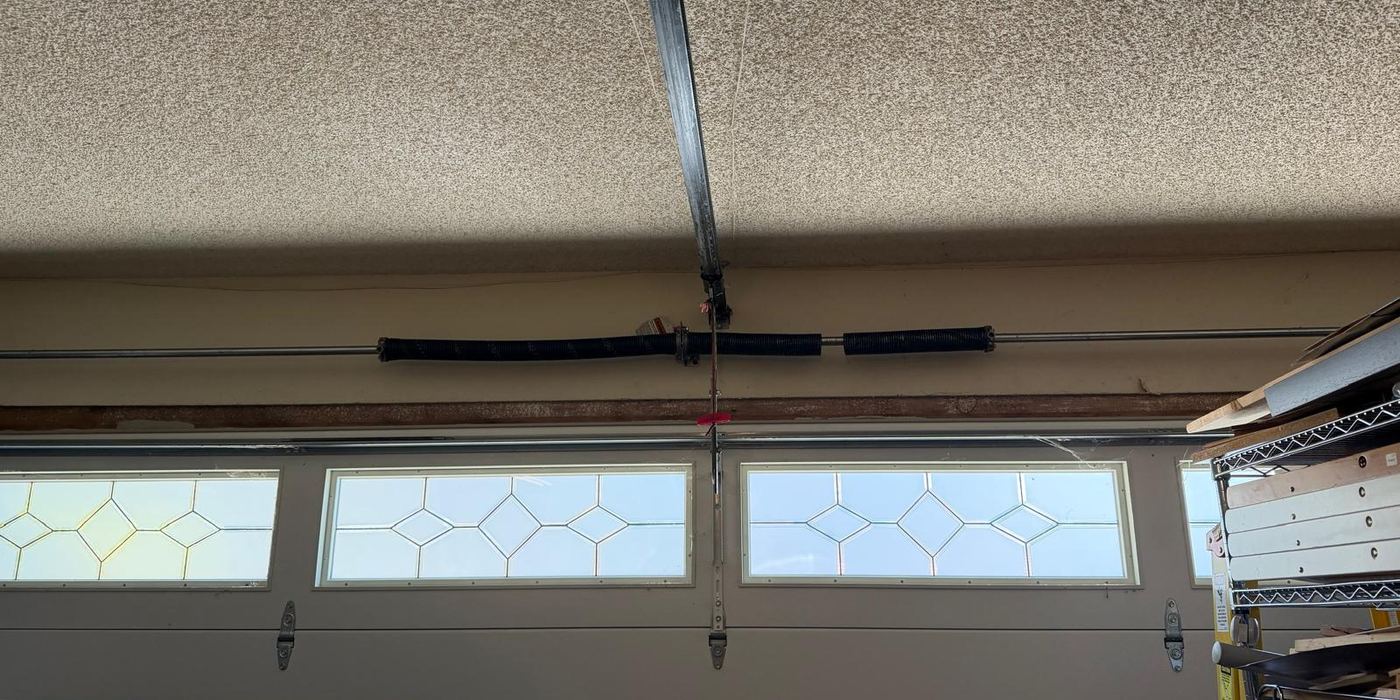
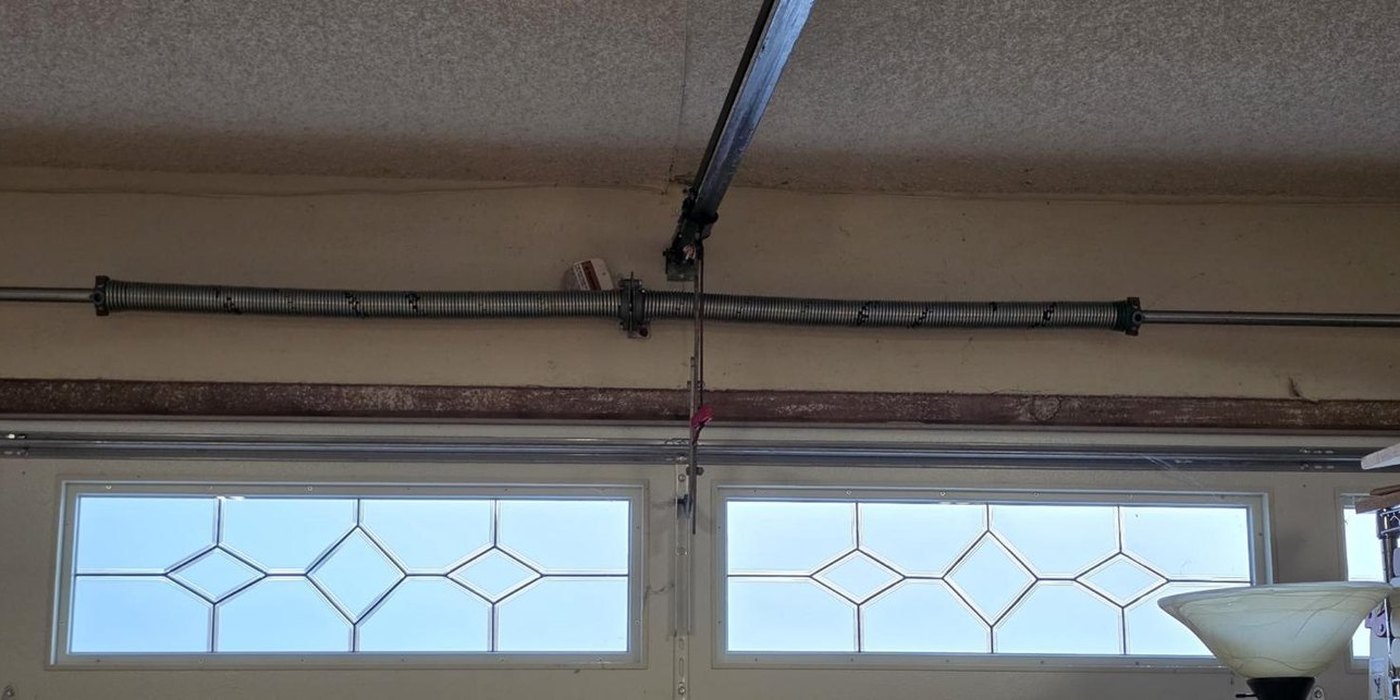
A real job in San Diego County. The extra length is the whole point: more coils means each cycle works the steel less, so the spring lasts far longer.
Don't ignore small problems
A door that's slow, noisy, or slightly uneven is telling you something. Catching a spring problem early — during a routine service or when you notice the door acting differently — almost always costs less than waiting until it fails completely.
7. What to do next
If your spring just broke, or you've noticed your door acting up and suspect the springs are the issue:
- Stop using the door. Don't run the opener until the spring is replaced.
- Call a licensed local company — not a national call center that dispatches unknown subcontractors.
- Get a written quote before approving any work.
- Ask about high-cycle upgrades if your door is heavily used.
Need a spring replaced in San Diego County?
We do same-day spring repair across San Diego County — clear written price, no surprises. CSLB Lic# 1081105.
Spring repair by area
We replace springs across San Diego County. Same-day availability most days.
See all 32 service areas →